Domain property or URL-prefix
A Domain property covers protocols and subdomains for one domain and uses DNS verification. It is a practical primary choice when you control the domain. A URL-prefix property covers only the exact prefix and supports more verification methods.
Montana WebStudio uses domain-level DNS verification. It does not depend on a page template, so a redesign or HTML change should not remove the DNS token.
| Type | Best fit |
|---|---|
| Domain | The full domain, protocols and subdomains |
| URL-prefix | One exact HTTPS prefix or site section |
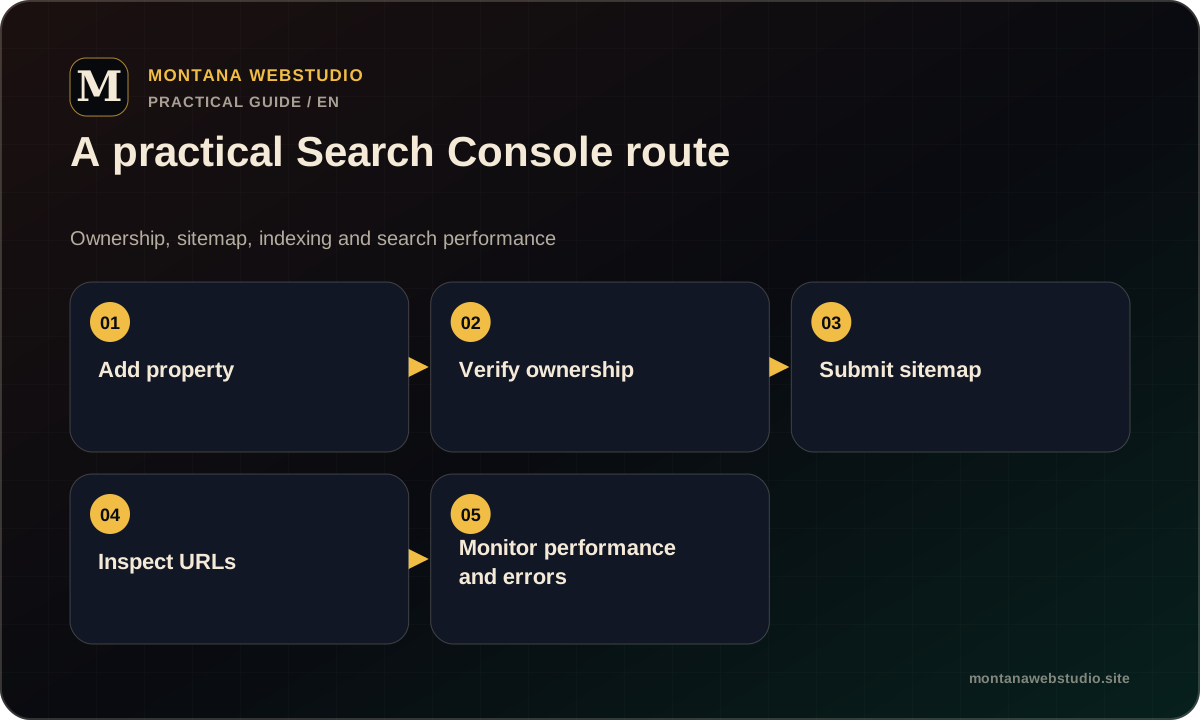
How to keep verification durable
Keep the verification token under business-owner control. When using an HTML file or meta tag, preserve it during template cleanup. With DNS, do not remove a TXT record until you know which services depend on it.
Grant collaborators access through Users and permissions instead of sharing a Google Account password. Access can be removed later without altering the verification token.
- Document the verification method.
- Never share the personal account password.
- Review access after a supplier change.
- Investigate an unknown token before deleting it.
Submit a clean sitemap
Open sitemap.xml first and confirm a 200 response. It should contain only canonical indexable URLs that are also reachable through internal links.
After submission, wait for processing and compare the URL count with your crawl. A successful read means Google fetched the file; it does not guarantee indexing of every page.
Use URL Inspection for diagnosis
URL Inspection shows Google’s known state and can test the live URL. Review access, declared and selected canonicals, robots and the last crawl date.
Request indexing is appropriate for a few important updated pages after the cause is fixed. Repeated bulk requests do not accelerate a weak or technically contradictory site.
- Enter the full canonical URL.
- Review Google’s known state.
- Run a live test when needed.
- Fix the specific cause on the site.
- Request indexing only after the fix.
A weekly and monthly routine
Weekly, review critical messages, manual actions and sharp indexing changes. Monthly, compare queries, pages, countries and devices without drawing a conclusion from a single day.
Separate technical and editorial problems. A 5xx response or noindex needs a fix. A crawled-but-not-indexed page may need stronger standalone value, consolidation or better internal navigation.
Ownership and handover
Search Console should remain under site-owner control. Developers or SEO specialists receive the permissions they need, while the business keeps at least one verified owner.
Record the property, verification method, owners, sitemap URL and latest check date in the handover notes. This reduces the risk of losing access when the team changes.
Frequently asked questions
Which property type is best for the whole site?
A Domain property when DNS access is available. It covers protocols and subdomains for the domain.
Should URLs be submitted every day?
No. Use the sitemap and internal links; reserve Request indexing for a small number of important pages after meaningful fixes.
Who should be the owner?
The business owner or a Google Account under business control. Suppliers can receive separate permissions without sharing a password.