What actually determines website cost
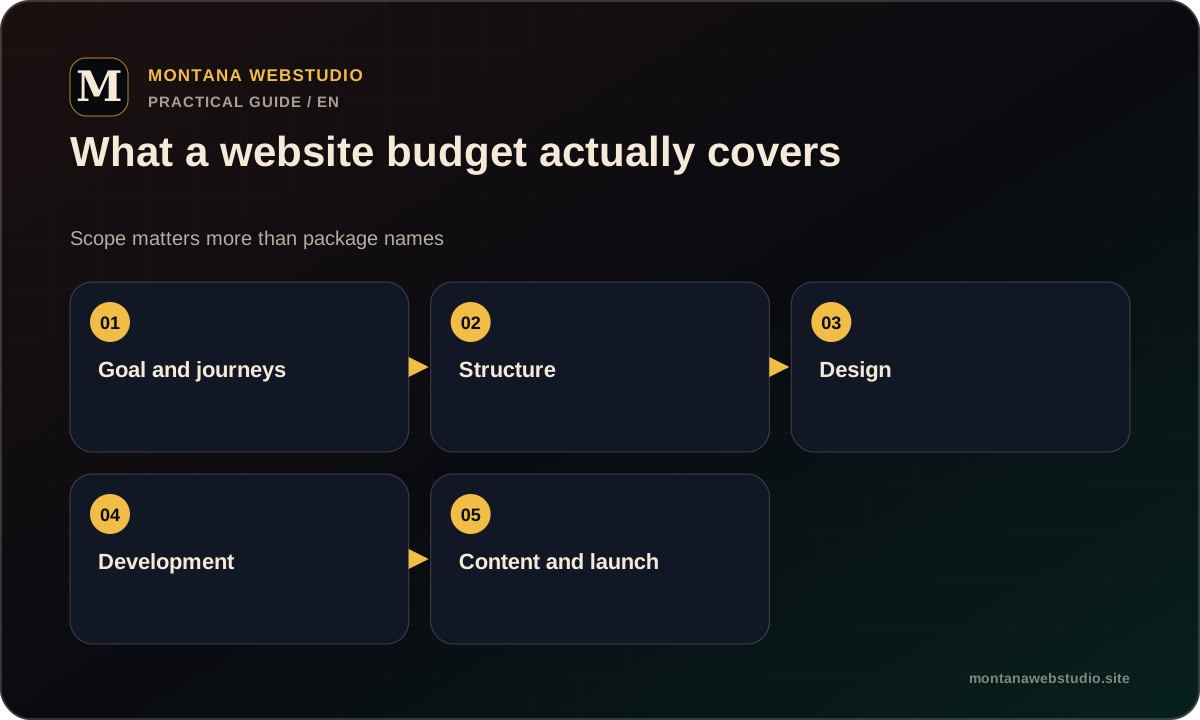
A website quote covers a chain of work: discovery, information architecture, design, responsive development, content management, forms, integrations, analytics and launch checks. Two ten-page websites can require very different effort when one uses repeatable layouts and the other contains custom interactions and business logic.
The number of unique page types is usually more useful than the total page count. Twenty service pages based on one component system may be simpler than five pages that each need a separate layout, calculator and data source.
- Structure: user journeys, page hierarchy and internal navigation.
- Design: an existing system, a customised template or a bespoke interface.
- Functionality: forms, catalogues, payments, filters, accounts and integrations.
- Content: writing, photography, translation, migration and entry.
- Launch: hosting, analytics, technical SEO, testing and handover.
How the project type affects the budget
A focused landing page normally has fewer user paths than a company website or online store. That does not make every one-page site inexpensive: a highly art-directed landing page with custom motion can take longer than a restrained multi-page site built from a consistent component set.
WordPress, Shopify, Webflow and custom development do not sit in one permanent price order. A platform is cost-effective when it matches the editing workflow, expected growth and maintenance model without forcing expensive workarounds.
| Format | Typical use | Main cost drivers |
|---|---|---|
| Landing page | One offer or campaign | Unique sections, copy, motion |
| Service website | Several services and search intents | Page templates, navigation, content |
| Online store | Catalogue, checkout and payment | Product import, filters, payments, operations |
| Web application | Accounts, roles, data and workflows | Business logic, backend, integrations, testing |
Costs that sit outside the build quote
Domains, hosting, premium fonts, plugin licences, third-party platforms and payment fees are normally billed separately. They are not necessarily hidden development charges, but they should be documented before work begins so the operating cost is clear.
Maintenance also needs an owner. Decide who will update content, check backups, respond to errors and plan improvements. If your team will manage the site, the project scope should include access handover and practical editing guidance.
What to prepare for an accurate quote
You do not need a long technical specification. A concise description of the product, audience, primary action, required pages, references, deadline and content readiness is enough to start a responsible estimate.
The Montana WebStudio project brief captures these essentials. It also helps separate the first release from optional improvements, keeping the budget under control without cutting critical user journeys.
- Define one primary business outcome for the website.
- List must-have pages and functions.
- Share two or three references and explain what is relevant in each.
- State whether copy, images, branding and the domain are ready.
- Provide a preferred timeline and a realistic budget range.
How to compare development proposals
Do not compare totals until you compare scope. Check whether responsive behaviour, CMS setup, content entry, forms, analytics, technical SEO, testing and handover are included in each offer. A lower price may simply omit work that another proposal has already covered.
Ask to see relevant launches and understand the approval process. You should know who makes technical decisions, how changes are documented and what you receive at handover. The Montana WebStudio portfolio shows the type of delivered work behind the estimate.
Frequently asked questions
Can a developer give a fixed website price without a brief?
Only a broad range is responsible without a brief. A fixed estimate needs at least the required pages, functions, content status and timeline.
Is WordPress always cheaper than custom development?
No. WordPress can reduce effort for content-heavy sites, while unusual functionality or a large plugin stack can increase both the build and maintenance cost.