The fundamental difference
WordPress is an established content management system with users, an editor, a media library, menus and a large extension ecosystem. A custom website is designed around specific workflows and does not have to follow the architecture of an existing CMS.
This is not a choice between quality and poor quality. A well-structured WordPress build can be fast and maintainable, while custom code can be unnecessarily complex. The reverse can also be true.
When WordPress is the better fit
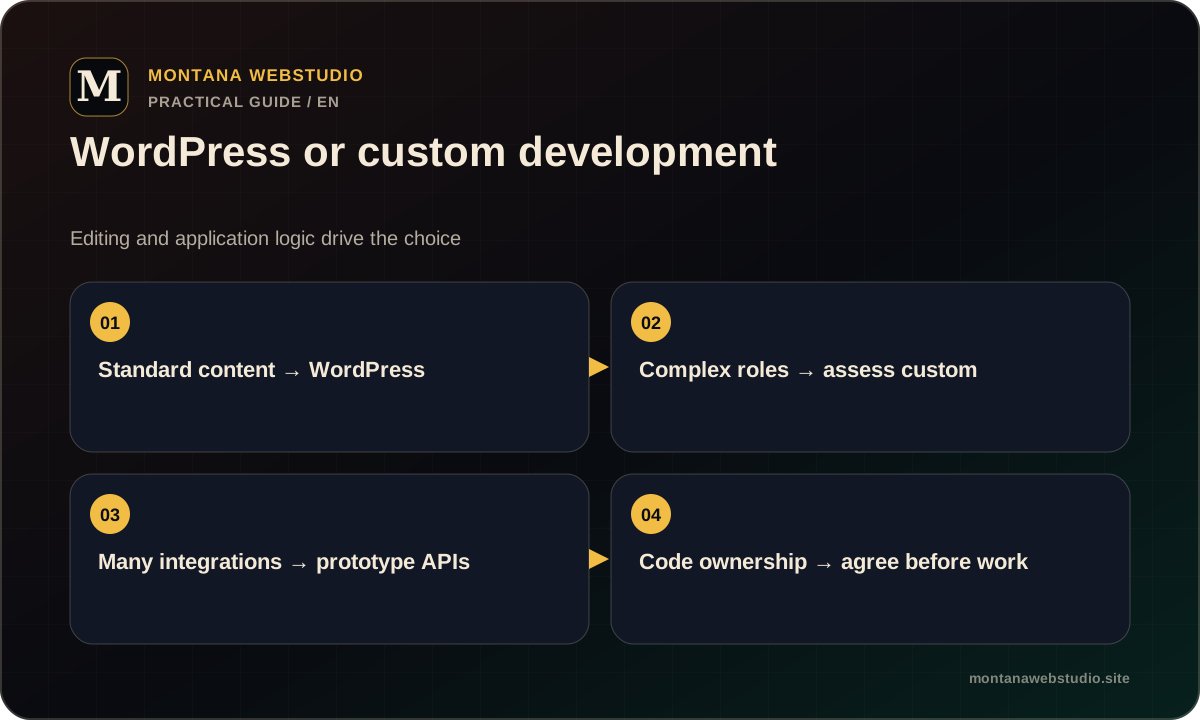
WordPress works well for service websites, blogs, publications, catalogues and company sites where a team regularly publishes or updates content. The existing administration layer reduces the work required for common editorial functions.
A reliable implementation uses intentional content types, controlled fields, clear templates and a limited set of trusted plugins rather than an arbitrary multipurpose theme. The WordPress development service explains this approach in more detail.
- Non-technical editors need to update content.
- Services, cases or articles use repeatable page structures.
- Editor and administrator roles are required.
- Core features can be covered without an excessive plugin stack.
When custom development is worth considering
A custom stack becomes useful when a product has unusual data, complex roles, customer accounts, automation or integrations that are difficult to maintain inside a general CMS. It also suits interfaces with strict performance and interaction requirements.
That freedom brings responsibility. Editing tools, authentication, security, backups and updates must be planned deliberately. Without documentation and handover, a custom product can become more dependent on its original developer than a mainstream CMS.
Comparison by practical criteria
For a content-led website, WordPress often shortens delivery. For a product with distinctive business logic, a custom stack may be easier to maintain because it is not constantly working around CMS constraints.
| Criterion | WordPress | Custom development |
|---|---|---|
| Editing | Established admin and roles | A CMS or editing layer must be designed |
| Initial delivery | Faster for familiar content patterns | Depends on required infrastructure |
| Custom workflows | Possible, sometimes with workarounds | Designed without CMS constraints |
| Updates | Core, theme and plugins | Application code and dependencies |
| Handover | Broad specialist market | Requires documentation and a maintainable stack |
How to decide without following trends
Describe the content model, user roles, integrations, expected traffic and frequency of change first. Then compare how each platform would implement and maintain the same requirements.
If the project fits WordPress strengths, rebuilding a basic editorial system adds little value. If most of the effort would be spent bypassing the CMS, a custom architecture may be the more honest long-term choice.
Frequently asked questions
Can WordPress support a unique visual design?
Yes. WordPress manages content and does not require a pre-built visual theme. A bespoke interface can be implemented as a custom theme.
Is a custom website always faster?
No. Performance depends on architecture, frontend code, hosting, images and third-party scripts, not only on the platform name.