What actually determines the budget
Ten thousand simple products with a clean import can be more predictable than one hundred products with complex variants, customer pricing and manual exceptions. Logic matters more than catalogue size alone.
Describe the buyer and operator journeys: how products enter the system, how stock changes, how orders are placed and where they go next.
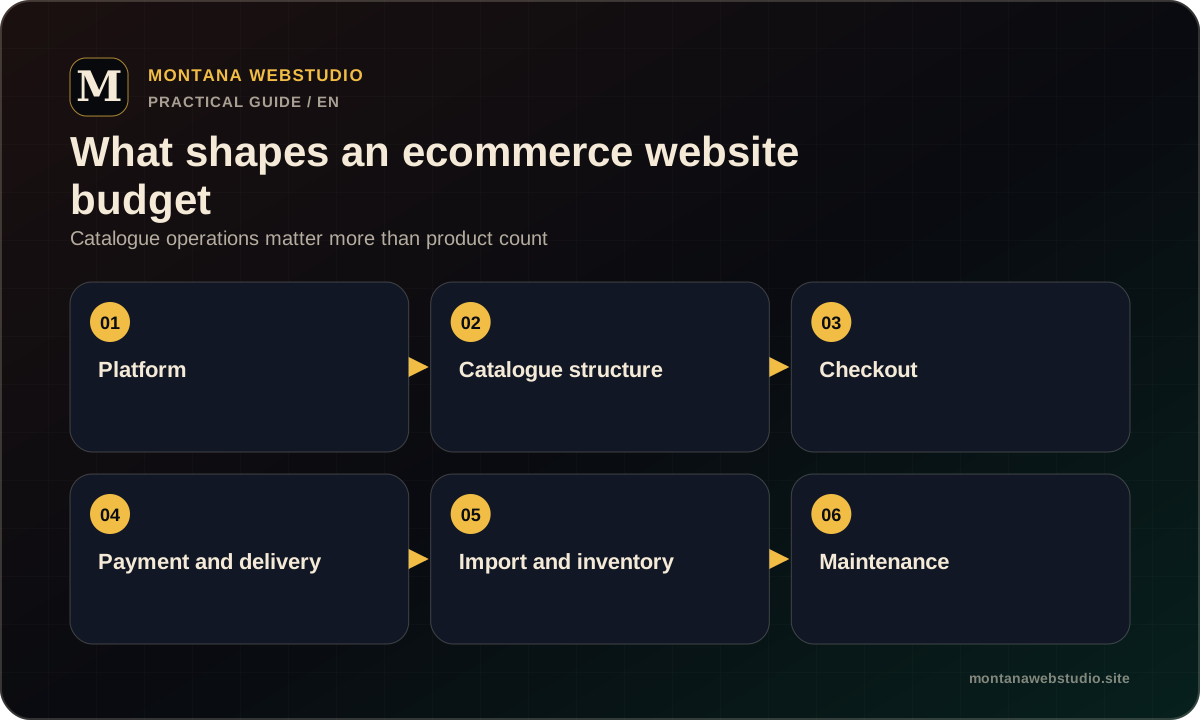
The main ecommerce workstreams
The first layer is the catalogue: categories, attributes, variants, filters, search and product pages. The second is the commerce flow: cart, checkout, payment, delivery, tax, emails and statuses.
The third is operations: imports, CRM/ERP, roles, returns, analytics and support. Even a standard integration needs access, sandbox testing and failure handling.
- Catalogue UX and responsive behaviour.
- CMS and product rules.
- Payment and delivery providers.
- Imports, APIs, webhooks and logs.
- Launch, analytics and a control order.
How platform choice affects cost
WooCommerce provides an open ecosystem and independent hosting but requires active plugin and server control. Shopify simplifies infrastructure while introducing plan and platform constraints.
OpenCart/ocStore or a custom stack can suit particular catalogues and integrations. Compare features, recurring cost, editors, regional payments and support rather than popularity.
| Question | Assess |
|---|---|
| Catalogue | Variants, filters and import |
| Markets | Languages, currencies and tax |
| Checkout | Payment, delivery and returns |
| Operations | CRM/ERP, warehouses and roles |
What to prepare for an estimate
Provide product and variant count, markets, currencies, payments, delivery, catalogue source, CRM and roles. Include one complex product and a real order journey.
The first release can then be separated from phase two. For example, launch the core catalogue and checkout before adding B2B pricing or complex automation.
Frequently asked questions
Can price be estimated from product count?
Only roughly. Data structure, variants, import and selling rules matter more.
Which is cheaper, Shopify or WooCommerce?
It depends on functionality, recurring fees, hosting, integrations and maintenance. There is no universal order.
Is product entry included?
It is a separate scope because manual entry, import and data cleanup have different complexity.