Why WordPress has no single price
WordPress is a content management system, not a fixed package of work. A small site using a commercial theme and a custom WooCommerce catalogue can run on the same CMS while requiring very different design, code and testing.
The estimate depends on unique templates, content modelling, editor permissions, integrations, data migration and maintenance. Plugin count alone is not a reliable measure of quality or complexity.
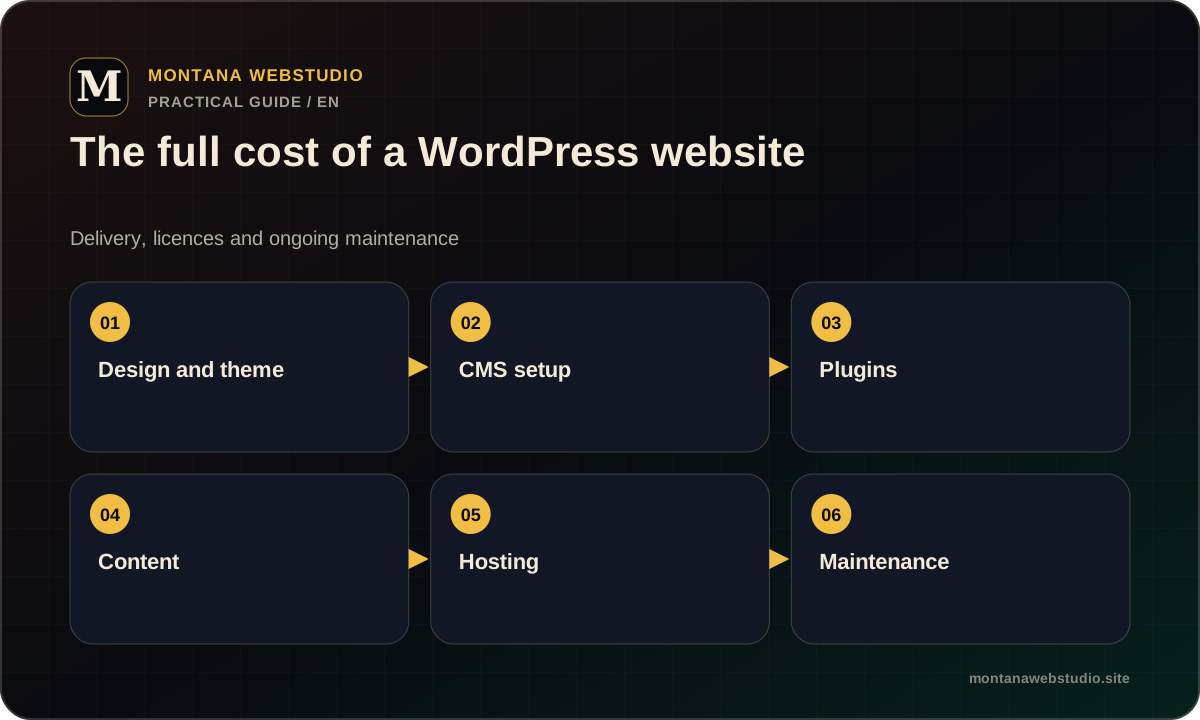
What belongs in the estimate
A custom theme covers structure, components, responsive behaviour, WordPress templates and controlled editing fields. With a commercial theme, effort moves into configuration, constraints and compatibility testing.
Catalogue, filters, multilingual content, forms, imports, roles, integrations and WooCommerce are separate requirements. Each should be described as a user journey rather than only a plugin name.
- Design: template, adaptation or a bespoke visual system.
- Content: post types, fields, editor permissions and migration.
- Functions: forms, catalogue, checkout, accounts and APIs.
- Launch: hosting, SSL, metadata, sitemap, analytics and access.
Recurring costs after launch
The owner pays for domain and hosting. Some plugins, themes, fonts and external services have annual subscriptions; these should be separated from development cost.
Maintenance includes backups, updates and verification of critical journeys. A cheap launch with many dependencies can cost more later, so total ownership matters.
| Cost | When it applies |
|---|---|
| Hosting and domain | Always |
| Paid licences | When a required feature depends on one |
| Maintenance | After launch and before risky updates |
| Further development | When the offer or workflow changes |
How to reduce cost without creating debt
Reduce the first release to essential templates and functions. A calculator, complex portal or automation can move to phase two when the main value works without it.
Do not cut backups, responsive behaviour, forms, HTTPS or ownership handover. These are baseline requirements, not decorative extras.
- Define one primary objective for the first release.
- Keep only the required page types.
- Reuse components rather than designing every page as a special case.
- Record phase two as a separate list.
What to send for an estimate
Provide a page list, examples, functional requirements, content readiness and information about the editors. For an existing WordPress site, include the URL, critical plugins and the reason for change.
After short discovery, the estimate can explain scope, dependencies and recurring costs, not only a total. If requirements change, the estimate should change transparently.
Frequently asked questions
Is a custom theme always more expensive?
It has a larger initial scope but can reduce builder dependency and simplify maintenance for the required templates.
Can free plugins be used?
Yes, when they safely cover the requirement. Licensing and alternatives should be evaluated alongside maintenance.
Who pays for hosting and licences?
Usually the owner pays providers directly so accounts and renewals remain under their control.