What discovery is for
Discovery turns “we need a website” into decisions: who it serves, what users should do, which pages and data are needed, who edits content and what a complete launch means.
It does not need to be a long consulting exercise. A small website may need one structured workshop and a document that removes the critical assumptions.
Business objective and user journey
Define one primary action: enquiry, call, order, booking or registration. Then identify what the user needs to understand before taking it.
Account for traffic sources. Brand search, paid traffic and an informational article provide different context, while the website should route each person to the relevant service.
- Who is the user and which problem are they solving?
- What is the primary website action?
- Which evidence builds trust?
- Where does the form data go after submission?
Pages, intent and content
Every priority page needs a separate reason to exist. Two pages answering the same intent compete internally and make navigation harder to understand.
A content plan records title, H1, key questions, related service and CTA. Real copy and media volume affect layout and should not be postponed until the end.
| Element | Discovery decision |
|---|---|
| URL | One primary intent |
| H1 | Natural page description |
| Content | Questions, evidence and limits |
| CTA | The next logical step |
Technical dependencies
Platform choice follows editing, data, integration and maintenance needs. WordPress, Webflow or custom development should not be selected only because the name is familiar.
Forms, CRM, payments, domain, hosting, analytics, languages and migration affect scope. Each external system needs an responsible person, access and test route.
- Who owns the domain and hosting?
- Which roles edit content?
- Which integrations have documentation and a sandbox?
- Are there old URLs that must be preserved?
What should exist after discovery
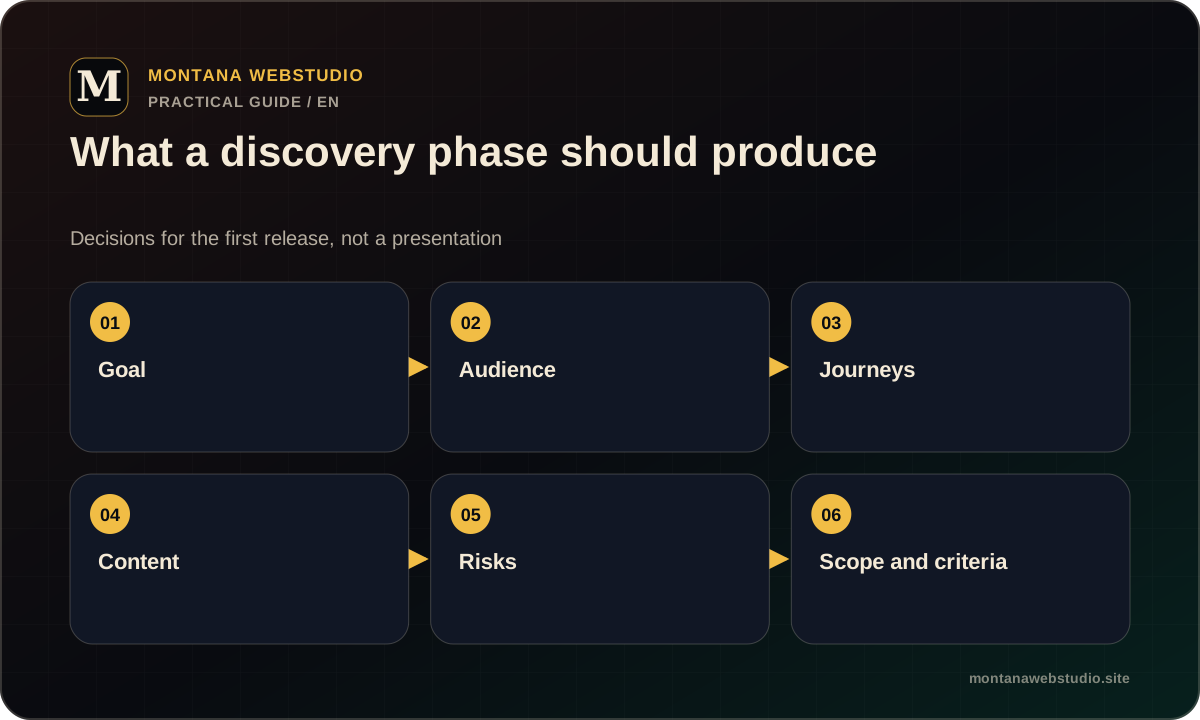
The minimum output includes the page map, template descriptions, functional scope, content responsible person, integrations, risks and acceptance criteria. An explicit out-of-scope list is also useful.
The team can then estimate timeline and cost, create wireframes and avoid reopening basic decisions on every design screen.
Frequently asked questions
Does a landing page need discovery?
Yes, in a shorter form covering offer, audience, traffic source, structure, form and measurement.
Who should participate?
The decision maker, someone close to sales or operations, and the person responsible for content or product.
Is discovery a separate service?
It can be a separate phase or part of development, depending on the level of uncertainty.