The short answer without false precision
A focused landing page, a multi-page website and a web application have different delivery cycles. Even within one format, the schedule changes with content readiness, unique templates, integrations, CMS requirements and the number of decision makers.
A useful timeline is therefore built from dependencies rather than a promise such as “a website in seven days”. Define deliverables and owners first, then sequence the work and reserve time for verification.
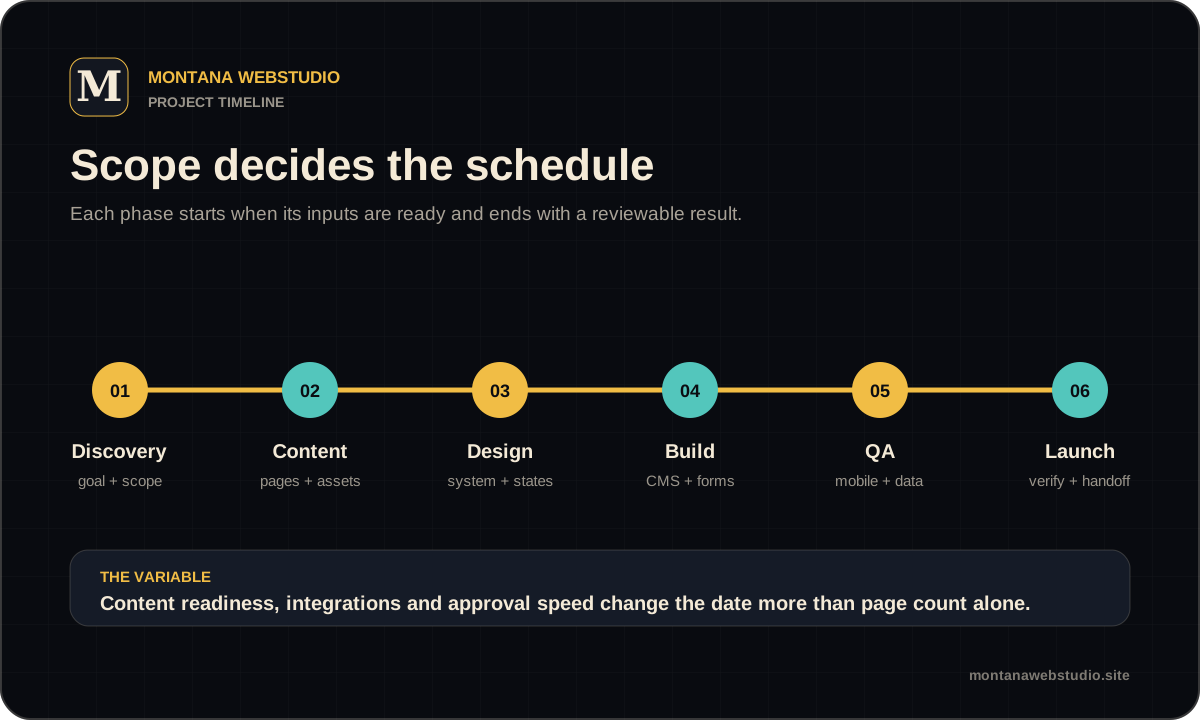
The stages that shape the schedule
Discovery and information architecture decide what will be built. Skipping them pushes unresolved questions into design and development, where changes cost more.
Design, development and content can overlap when templates and responsibilities are clear. Launch remains a separate stage covering forms, responsive behaviour, metadata, redirects, analytics and access handover.
- Define the objective, audience, pages and critical functions.
- Approve the structure and one representative template.
- Establish components and responsive rules.
- Implement CMS, forms and integrations.
- Add content, test and complete the launch checklist.
What usually delays a website project
The most common blocker is not code but missing content or a business decision. If copy, images, legal pages or access arrive at the end, finished components need to be reworked.
The second factor is uncontrolled scope. A new feature may be valuable, but it should either extend the schedule or move to a later release rather than silently entering the current one.
- One accountable reviewer reduces contradictory feedback.
- Real copy exposes structural problems earlier.
- Staging enables verification without risking the live site.
- A clear out-of-scope list protects the release date.
How to get a more reliable estimate
For an initial estimate, describe the website type, unique page templates, CMS, forms, integrations, content readiness and desired launch window. The required first release can then be separated from phase two.
The estimate becomes more precise after structure or technical discovery. This is normal: uncertainty is reduced through decisions, not through an artificially exact number given too early.
| Question | Why it changes the timeline |
|---|---|
| How many unique templates? | Each needs design, responsive rules and QA |
| Who prepares content? | A page cannot be verified without real copy and media |
| Which integrations? | External APIs have their own access and constraints |
| Who approves work? | Review time is part of the schedule |
When a website is genuinely ready to launch
Approved designs or uploaded files do not equal a finished project. Forms must work, HTTPS and canonicals must be correct, sitemap and robots rules must match intent, mobile states need testing, and ownership access must be handed over.
After release, priority URLs, enquiries and analytics should be checked again. A short post-launch support window is sensible, but it should not replace basic testing before publication.
Frequently asked questions
Can website development be accelerated?
Yes, by reducing the first release, preparing content and keeping reviews fast. Skipping QA is not a safe shortcut.
Can work start without finished copy?
Discovery and structure can start, but accurate design needs at least realistic draft content.
When should the launch date be fixed?
After scope, dependencies, owners and the readiness of critical materials are clear.