1. Indexability and access
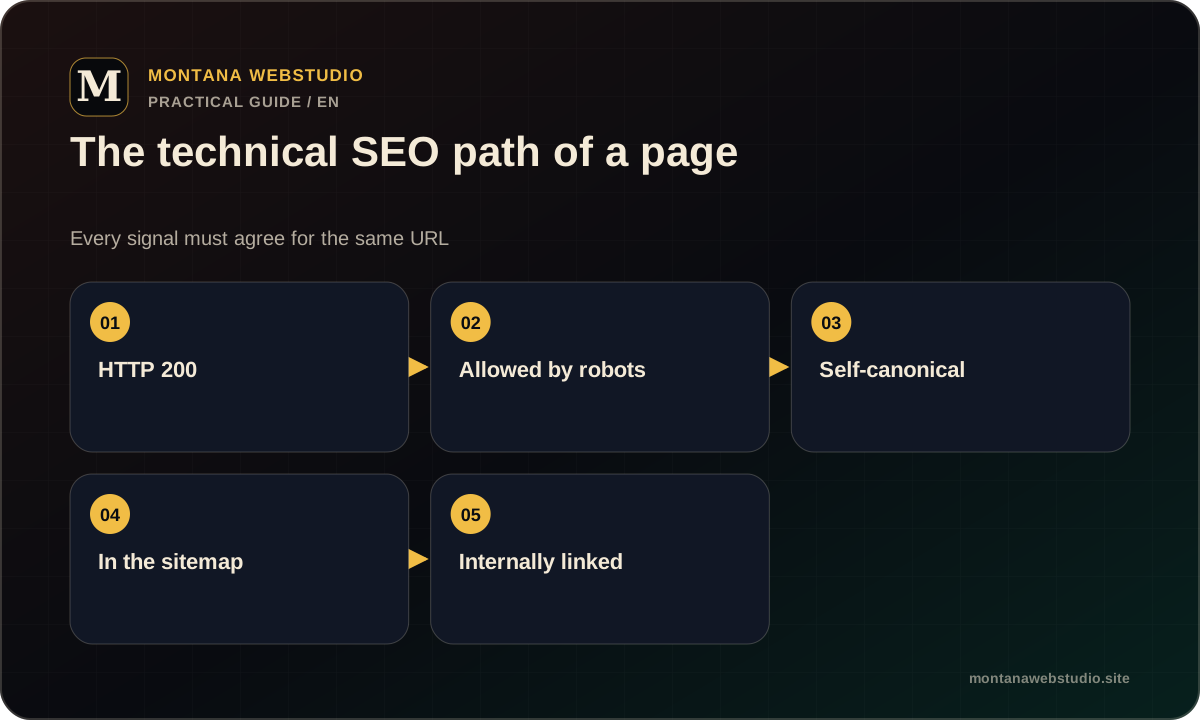
Start with server responses. Priority pages should return 200, removed content should return 404 or 410, and moved content should use one clear 301 redirect. Redirect chains and soft 404 responses complicate crawling and reporting.
Review meta robots, the X-Robots-Tag header and robots.txt. Robots.txt controls crawling but is not a dependable way to remove an already known page from search. Use noindex for appropriate utility pages while keeping valuable content accessible.
- The home and commercial pages work without authentication.
- No accidental noindex or Disallow blocks important sections.
- HTTP, HTTPS, www and non-www resolve to one preferred host.
- The custom 404 page returns an actual 404 status.
2. Canonicals, hreflang and duplicate URLs
Every indexable page should normally have a self-referencing canonical. A canonical is a hint rather than an absolute directive, so internal links, the sitemap and redirects should reinforce the same preferred URL.
Hreflang must be reciprocal for genuine language equivalents: the Ukrainian page references the English page and the English page links back. Do not add hreflang when one page is incomplete, unrelated or only superficially similar.
3. Metadata, headings and page content
Check unique titles and descriptions, one descriptive H1, logical H2 and H3 headings and content that satisfies the page intent. Search engines may rewrite descriptions, but a good description still provides a concise, distinct summary.
Meaningful images need useful alt text and explicit width and height; decorative images should use empty alt text. Open Graph and Twitter Card markup do not directly improve rankings, but they control how a shared link appears in social and messaging apps.
4. XML sitemap and structured data
The XML sitemap should contain only canonical, indexable URLs that return 200. Drafts, 404 pages, redirects and duplicates do not belong in it. Update lastmod only after a meaningful content change rather than on every build.
Structured data must describe visible, truthful content. BlogPosting and BreadcrumbList suit an article; Service can suit a genuine service page. Do not invent ratings, reviews, prices, authors or awards.
5. Mobile quality, performance and measurement
Test representative phone widths, horizontal overflow, tap targets, navigation, forms and wide tables. Images should use appropriate dimensions and formats, while critical content should not wait for unnecessary scripts.
Analytics should record useful actions as well as page views: successful form submissions, phone clicks and messaging links. After launch, add the property to Search Console, submit the sitemap and inspect priority URLs. The technical SEO service covers this launch foundation without claiming guaranteed rankings.
| Area | Check | Expected outcome |
|---|---|---|
| Indexing | robots, noindex, status codes, redirects | Crawlers reach the intended URLs |
| Signals | canonical, hreflang, sitemap | Preferred versions are consistent |
| Content | title, description, H1-H3, alt | The topic is unambiguous |
| Experience | mobile, forms, 404, performance | Priority journeys work |
| Measurement | analytics and conversions | Launch outcomes can be evaluated |
Frequently asked questions
Is an XML sitemap enough to get a website indexed?
No. A sitemap helps discovery, but a page must also be accessible, canonical, useful and connected through internal links.
Does technical SEO guarantee high rankings?
No. It creates a correct technical foundation. Rankings also depend on demand, competition, content, reputation and continued improvement.